Seventeenth-century Strings
–
About Seventeenth-century Strings
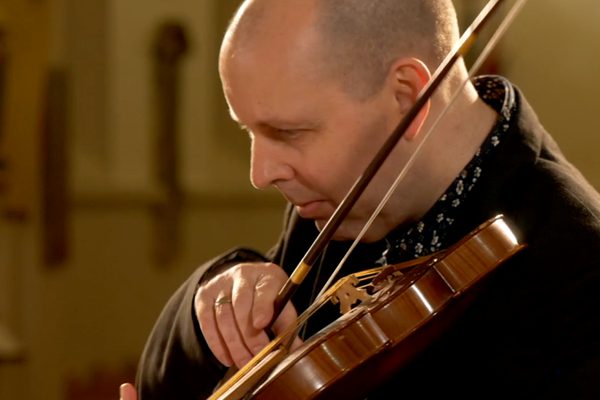
Explore some of the most intriguing string music of the baroque era in this course focusing on the 17th century – the age of ‘wonder and delight’ in the arts, in which the ability to astonish was the hallmark of every great musician. Learn about stylish ornamentation, dance characters and rhetorical performance while honing your consort & ensemble playing, guided by baroque violinist and director of the highly acclaimed Monteverdi String Band, Oliver Webber.
What is the course about?
This course explores string ensemble repertoire from around 1600 to 1700. Alongside well known composers such as Monteverdi, Lully and Biber, you’ll also discover lesser known figures who wrote brilliantly for strings including Thomas Simpson, Legrenzi and Muffat. Each year we choose a mix of consort and orchestral music that offers an introduction to the distinctive soundworld of the 17th century, intricate inner parts for second violins and violas, a chance to develop refined bow control and a rhetorical approach to articulation, and a variety of ornamentation styles for you to experiment with.
In our main sessions, we alternate between tutti orchestral work and small group consort playing so everyone can try improvised ornamentation techniques. We learn these through simple ornament games to build confidence and spontaneity. Anyone who wishes to take part in the smaller groups can do so, although it isn’t required. You can explore this further during the free afternoon sessions.
Please note, this is an A415 course for period instruments.
What will you learn?
By the end of the course you will:
- Play with a greater understanding of 17th-century principles of string ensemble playing
- Perform a range of different kinds of ornamentation, and have an improved understanding of how and when to apply them
- Play with improved bow control and nuanced articulation, matching and responding to your colleagues
- Recognise, appreciate and enjoy different genres and characters of 17th century string music: canzonas, ensemble sonatas, music for theatre and dance, and ornamented madrigals.
How will the course be taught?
The course will encompass a few different styles of working:
• tutti sessions learning repertoire and exploring 17th-century style in general
• tutti sessions focusing on specific aspects of style: bowing, tuning, ornamentation, articulation
• opportunities to experiment with smaller-scale consort repertoire, one to a part During the tutti sessions, there will also be some small-group work to explore particular techniques, especially ornamentation, that all will benefit by seeing and hearing.
Everyone who wishes to will have an opportunity to play in these, but there is no pressure to do so. Comments, observations and suggestions will be invited from those not playing! Although the course is primarily ensemble-based, individual guidance and coaching will be offered throughout, and questions about technique, style or instruments are always welcome at any stage. Please note, this is an A415 course for period instruments.
Who is the course for?
This course is for players of baroque bowed string instruments – though it is not ideally suited to double bass. Baroque violins, violas, cellos or bass violins will form the core of the ensemble; violones are also welcome, ideally in G. Violas are especially welcome: if you are a violinist who also plays viola, please consider applying as a viola player. The repertoire is particularly rewarding for the violas! Baroque instruments are needed for this course; if you are able to string your instrument in all gut, that’s ideal, but not a requirement. Similarly, if you have a choice of bows, please bring the earlier model. Oliver is happy to answer questions from applicants about individual instruments and to offer guidance about set-up and equipment. For this course you will need some experience playing baroque orchestral music to a reasonable standard. Good sight-reading skills are an advantage, but music will also be sent out in advance on request.
If you would like guidance on if you are the correct standard for this course, here is a sample piece of music. If you can play this with confidence you will be at the right level for the course.
‘Everyone I spoke to said how much they appreciated your huge expertise and learning new things.’